Moving Your Construction Team from Independence to Interdependence
By Eileen Sien, P.E., MIPI
This summer, we celebrated the 250th anniversary of our country’s independence with music, friends and fireworks. Adding to the festivities, my husband and I have been in the thick of wedding season, attending six weddings in the past three weeks alone.
During the most recent wedding, the officiant said something that stuck with me:
“You are both strong, smart, loving and whole individuals. The work now is learning to build a life that’s better together than either of you could build alone.”
Everyone raised a glass. Nobody mentioned that this is also, almost word for word, the hardest part of the first year of marriage, and often beyond.
Before the wedding, both halves of that couple ran their own lives well: their own careers, finances and calendars. Each was independent, capable and thriving. Then they move in together, and “my budget” becomes “our budget.” “My decision” quietly stops being theirs alone to make.
The couples who struggle most usually aren’t short on independence. They struggle because independence, on its own, was never intended for two people rowing the same boat.
Stephen Covey mapped this same shift in The 7 Habits of Highly Effective People: a maturity continuum that moves from dependence to independence to interdependence. Interdependence isn’t a step down from independence. It’s a step beyond it, where two capable, self-reliant people combine their strengths to create something neither could build alone.
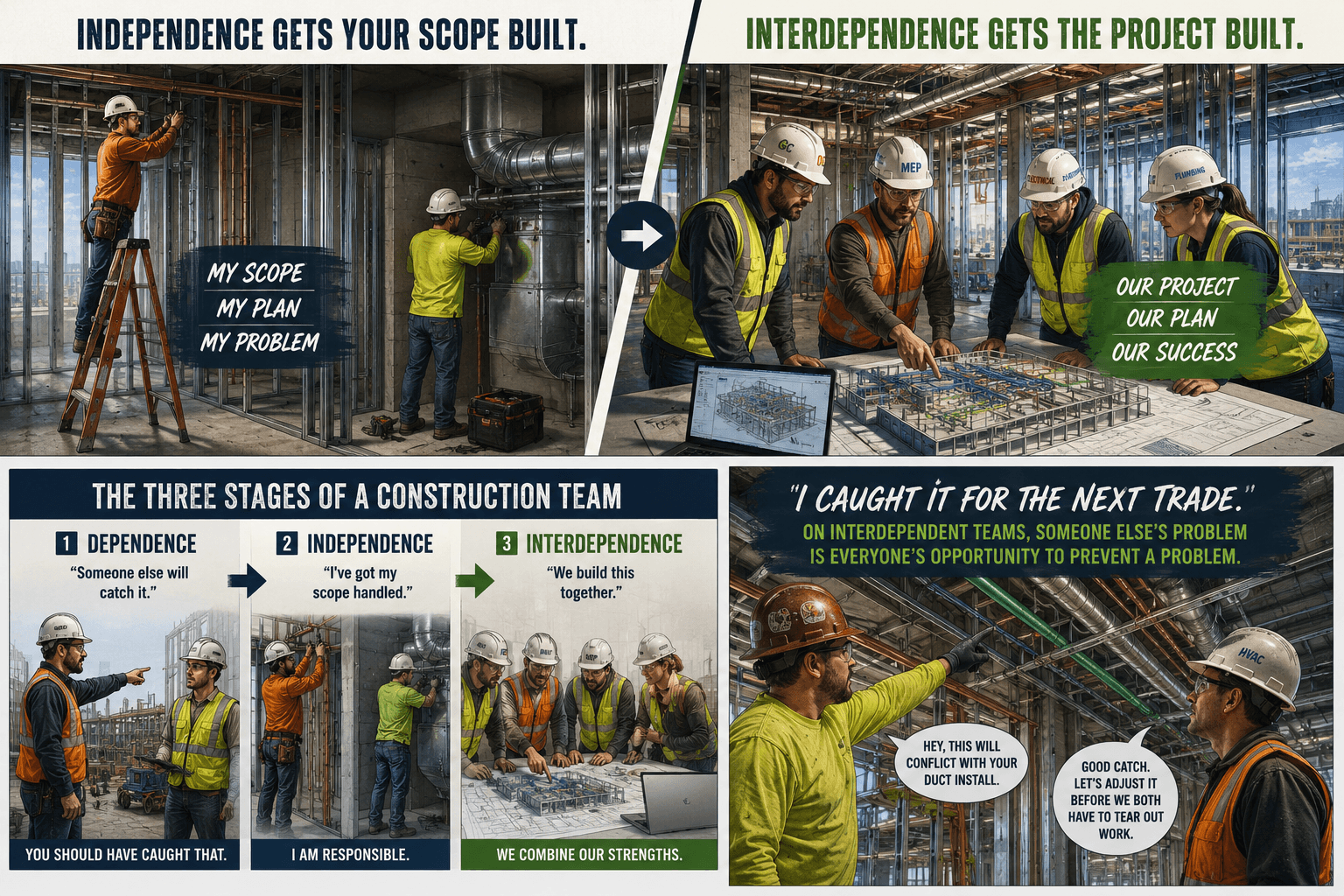
Construction teams navigate the same journey on every project. Most get very good at independence. Fewer make to the deliberate shift to interdependence. And that gap is where budgets and schedules quietly go to die.
1. Dependence: “Someone else will catch it”
This is the “you” paradigm, as Covey frames it: You should have caught that. You didn’t tell me. You are responsible.
On a jobsite, dependence looks like:
- Subcontractors waiting on an RFI response before flagging an obvious field conflict
- Coordination issues elevated to the project manager or superintendent instead of resolved trade-to-trade
- Teams staying quiet about a risk early on, then defaulting to contractual positions when the issue eventually surfaces
CALL TO ACTION: In your next meeting, ask every trade contractor to name one risk they haven’t raised yet, and thank the first one who does.
2. Independence: “I’ve got my scope handled”
This is the “I” paradigm: I am responsible. I am capable. I deliver what’s mine. It’s necessary, and it’s also where a lot of strong teams get stuck. Two great individual performances, parked side by side instead of merged into one.
On a jobsite, independence looks like:
- Clash surprises discovered during installation instead of model coordination
- “My scope” language dominating OAC and coordination meetings
- Strong individual trade performance paired with weak integration between trades
- Schedule float held and protected by each trade separately, rather than shared
CALL TO ACTION: In every coordination meeting, add one question: “What does this decision cost the trade partner working alongside you?”
3. Interdependence: “We build this together”
Covey called interdependence a far more advanced paradigm than independence: the “we” paradigm, where people combine their talent and effort to achieve results none of them could reach alone.
On a high-performing jobsite, interdependence looks like:
- Trades flagging conflicts on someone else’s scope before it becomes their own problem
- Joint model coordination sessions happening before drawings are finalized, not after
- Look-ahead schedules built together by trades, rather than handed down from the general contractor
- A field culture that treats “I caught something for the next trade” as a win worth mentioning
CALL TO ACTION: Put one joint coordination session on the calendar this month, before drawings are finalized, not after.
The Takeaway
Construction rewards independence by default. The contract divides the scope into pieces, and everyone is measured against their own piece. But the really successful projects, the ones that have everyone looking forward to working together again, are the ones where the team moves beyond independence and intentionally embraces interdependence.
Like every marriage, every project requires two forms of readiness: how well you handle your own responsibilities and how well you integrate them with the responsibilities of your partners.
CALL TO ACTION: Before your next milestone meeting, ask your team: Are we independent right now, or interdependent?
P.S. And be sure to celebrate that interdependence!