
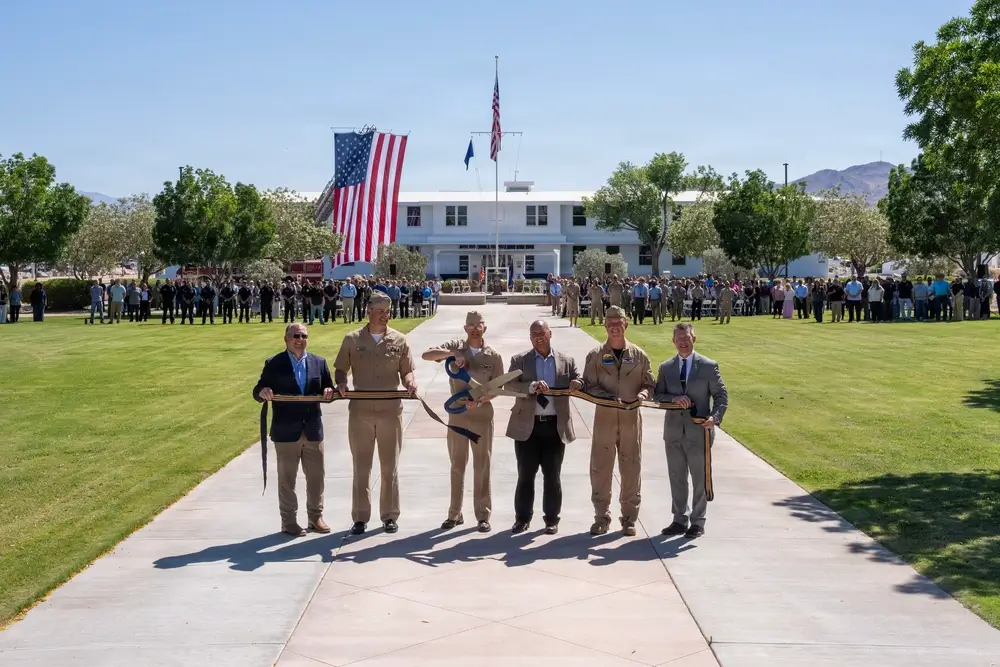
Seven years after two powerful earthquakes devastated Naval Air Weapons Station (NAWS) China Lake, military, government and industry leaders gathered to celebrate a milestone years in the making: completion of the final recovery project.
The June 23 ribbon cutting of the NAWCWD/NAWS headquarters building, known as the “White House,” marked the conclusion of one of the largest and most complex military reconstruction efforts in the nation’s history. The nearly $4 billion recovery program restored critical facilities damaged by back-to-back magnitude 6.4 and 7.1 earthquakes that struck the Ridgecrest, California area in July 2019.
While the final ribbon cutting represented the completion of a significant construction milestone, it also celebrated something equally important: the power of collaboration.
VELO Group supported this historic recovery effort by facilitating construction partnering on 30 earthquake recovery projects, helping project teams align around shared goals, strengthen communication, and create a culture of trust and accountability.
Led by construction partnering facilitator and VELO Group President Neal Flesner, the partnering process brought together stakeholders from Naval Facilities Engineering Systems Command (NAVFAC), Officer in Charge of Construction (OICC) China Lake, NAWS China Lake, Naval Air Warfare Center Weapons Division (NAWCWD), contractors, designers and other project partners.
A Recovery Effort Built on Teamwork
Following the earthquakes, NAVFAC established OICC China Lake to oversee the reconstruction and repair of the damaged facilities required to restore operations at NAWS China Lake and NAWCWD.
The recovery program included critical research, testing, administrative, aviation, and support facilities needed to maintain the installation’s mission of advancing naval capabilities and supporting national defense.
The scale of the effort was unprecedented. Teams had to rebuild while maintaining ongoing operations, coordinate numerous stakeholders, navigate supply chain challenges, support a large construction workforce and deliver projects on accelerated schedules.
Success required more than construction expertise. It required a unified commitment to working together.
Partnering Created a Framework for Success
Throughout the recovery program, construction partnering provided a structured process for teams to communicate openly, resolve challenges proactively and maintain alignment around common objectives.
Partnering sessions focused on key priorities, including safety, quality, schedule, budget, issue resolution, communication, teamwork and mission success. By creating a forum for honest discussions and collaborative problem-solving, these sessions helped teams identify obstacles early, establish commitments, and maintain momentum across a complex portfolio of projects.
The approach reinforced that successful projects are built not only through technical execution but through strong relationships among the people responsible for delivering them.
Collaboration in Action
One of the early challenges in the recovery effort involved housing thousands of skilled workers needed to rebuild the installation while minimizing impacts on the surrounding Ridgecrest community.
Through collaboration among project stakeholders, the team developed a 1,300-unit temporary contractor berthing camp that provided housing, dining, recreation, and support services for the construction workforce. Despite the challenges of the COVID-19 pandemic and global supply chain disruptions, the team delivered housing for the first 400 residents in just over four months and continued expanding capacity in alignment with project milestones.
The innovative solution helped attract and retain skilled labor while supporting the community during one of the largest construction efforts in the region.
Another major component of the recovery program was the $776 million South Airfield program, which included six projects delivered under a single multiple award construction contract. The 144-acre effort included a new fire rescue station, air traffic control tower, two hangars, and an Air Wing Integration and Interoperability Lab.
Through strong alignment and collaboration, the project team completed the work within an aggressive 31-month schedule while achieving high standards for safety, quality and performance.
The China Lake Way
During the program’s final ribbon cutting ceremony, leaders reflected on the importance of rebuilding more than facilities. They highlighted the culture of collaboration known as the “China Lake Way.”
This approach brings together military and civilian teams, scientists, engineers, contractors, and community partners to solve complex challenges and advance innovation.
That same spirit of teamwork was central to the success of the earthquake recovery program.
“The success of a program this complex was driven by people coming together around a shared mission,” said VELO Group President Neal Flesner. “Construction partnering created the foundation for open communication, trust, and collaboration that helped these teams overcome challenges and deliver results.”
A Lasting Legacy of Partnership
The completion of the China Lake Earthquake Recovery Program represents more than restored buildings. It demonstrates what can be achieved when diverse organizations commit to a common goal.
From temporary workforce housing to advanced research and testing facilities, the program demonstrated the value of collaboration, innovation, and proactive problem-solving.
VELO Group is proud to have supported NAVFAC, OICC China Lake, contractors, and project partners throughout this historic effort. The lessons learned from China Lake will continue to serve as an example of how construction partnering helps teams successfully navigate complexity and deliver mission-critical projects.
Seven years after the earthquakes, China Lake has finished the work — together.
Related Blog Posts and Case Studies:
China Lake Cuts the Ribbon on Final Recovery Project
Celebrating Recovery and Resilience Five Years After the Ridgecrest Quake
Partnering Spurs Navy Seabees Skills Mentoring Program
Naval Air Weapons Station China Lake South Airfield Earthquake Recovery Project
