Project info
- Case Studies, Featured
Sound Transit
South County Transit Partners
Kiewit Infrastructure West Co.
Kiewit Engineering Group, Inc.
Project Description
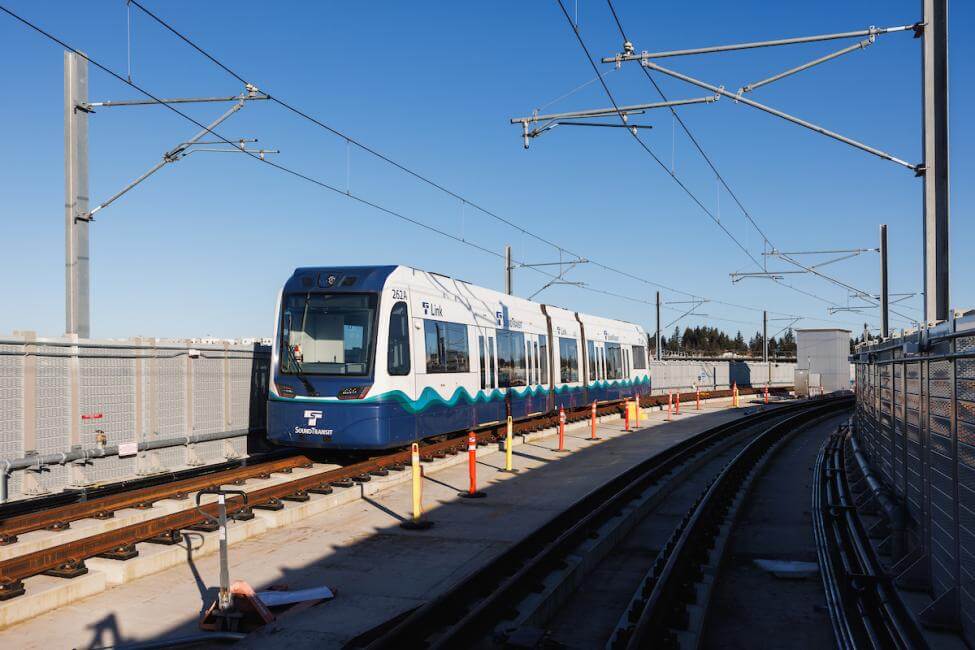
Sound Transit’s Federal Way Link Extension (FWLE) program was developed to address increasing road congestion and growing travel demand along the I-5 corridor while providing a reliable, high-capacity alternative for connecting communities to Sea-Tac International Airport, downtown Seattle and the University of Washington.
Spanning four municipalities, the large-scale transit program extended 7.8 miles of light rail from SeaTac’s existing Angle Lake Station to Federal Way. The project included a mix of at-grade segments, cut-and-fill sections and 2.5 miles of elevated guideway supported by eight bridges. The team’s scope entailed design, construction, testing and commissioning of three new stations and parking garages, new street networks, electrical systems, signaling and communications infrastructure.
In addition to extensive coordination of multiple stakeholders in this high-profile public project, the design and construction team faced myriad challenges including technically complex geotechnical conditions, more than 350 permits across multiple jurisdictions, and integration with an active rail system. A notable innovation was the redesign of a critical structure as a 500-foot balanced-cantilever bridge, improving seismic performance while minimizing environmental and roadway impacts. The team also implemented 53 alternative technical concepts, 34 of which were approved, generating approximately $70 million in savings while enhancing constructability and long-term performance.
Delivered through a firm fixed-price, design-build contract, the project team leveraged construction partnering to align design, construction and systems integration from the outset, enabling proactive risk management and disciplined execution over the six-year delivery period. With the opening of this crucial extension, the system is projected to add 20,000 to 30,000 daily riders, enhancing connectivity to bus networks and pedestrian pathways, while creating opportunities for new development on adjacent parcels.
Partnering Approach
Partnering was foundational to the success of FWLE, establishing a unified team culture across the owner, contractor, designers, and multi-jurisdictional stakeholders. Guided by VELO Group as a professional neutral facilitator, the project began with a formal kickoff workshop that brought executive leadership together to define shared goals and behavioral expectations that extended beyond contractual requirements. These commitments were documented in a Partnering Charter and reinforced throughout the project, driving team alignment and consistent, predictable performance.
A structured issue resolution ladder, ensured challenges were addressed at the lowest possible level, supported by a shared issue log and clear escalation protocols. This disciplined approach enabled the team to resolve more than 1,200 issues mitigating escalation to formal disputes. Through coordinated workshops and permit summits, partnering also extended beyond the core team to municipalities, utilities, and agencies, supporting alignment across hundreds of approvals.
Momentum was sustained through quarterly facilitated follow-up partnering sessions and milestone-based check-ins, where survey results, emerging risks and team alignment were openly discussed. Fostering continuous improvement between meetings, the partnering surveys were a critical feedback tool, measuring communication, trust, and performance. Co-location and strong field-level engagement enabled real-time collaboration through daily coordination meetings, joint safety walks, and open dialogue.
By embedding Partnering into both leadership strategy and daily operations, the team turned collaboration into a performance driver, strengthening relationships while improving cost, schedule and quality outcomes.
Partnering Results
- Completed ahead of schedule
- Delivered within budget
- Established a strong safety culture
- Resolved issues with no formal disputes
- Developed innovative, constructable solutions
- Achieved high-quality, first-time-right outcomes and strong long-term operability
- Maintained proactive community engagement
- Fostered strong collaboration, trust, and open communication
- Built lasting professional relationships across the project team
Project Notes
- Project Cost: $1.7 billion
- Personnel Hours: 2,093,622
- Delivery Method: Design-Build
- Construction Start: May 2019
- Construction Completion: October 2025
- Revenue Service: December 2025
Awards
Institute for Sustainable Infrastructure, 2024 Envision Platinum Award