Project Description
Wahiawa, Oahu, Hawaii
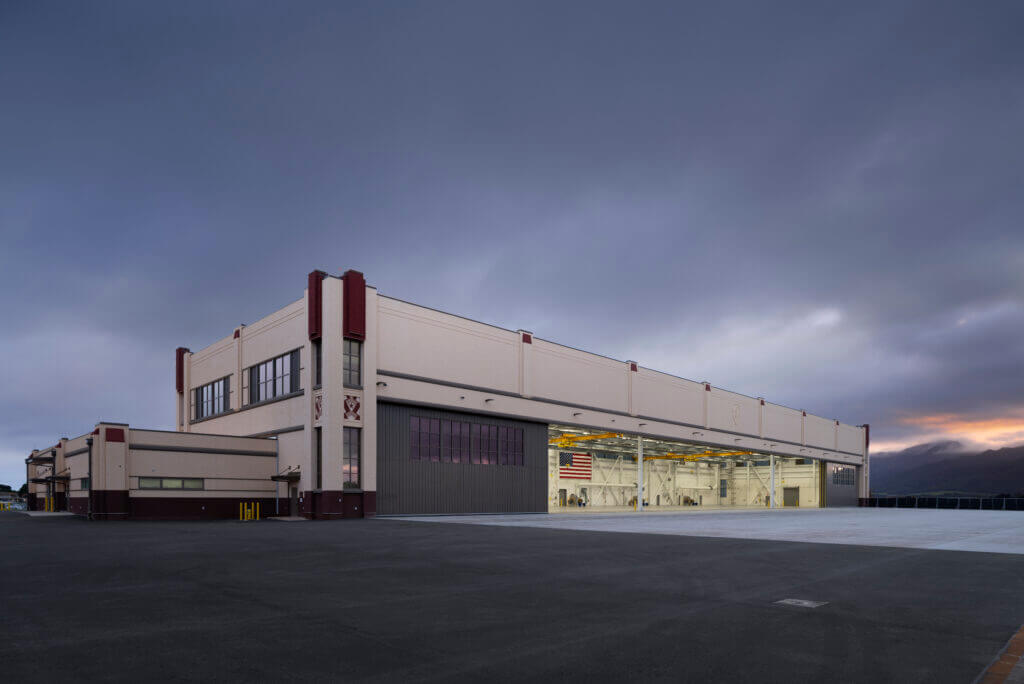
The Wheeler Army Airfield Aircraft Maintenance Hangar is a critical U.S. Army infrastructure investment delivered through a deliberate construction partnering approach focused on collaboration, transparency, and mission readiness. Located in central Oahu, the three-story, 88,000-square-foot rotary-wing aircraft maintenance hangar replaces aging World War II–era facilities with a modern, purpose-built environment designed to support the U.S. Army’s evolving aviation mission in the Pacific.
The new facility includes a high-bay maintenance hangar capable of housing six UH-60 Black Hawk helicopters, supported by two 10-ton bridge cranes that enhance operational efficiency and safety. Adjacent low-bay spaces provide comprehensive aviation support functions, including maintenance and repair shops, aviation and life support equipment areas, quality control and production control spaces, logistics and storage rooms, an arms vault, non-destructive inspection areas, mechanical and electrical rooms, and administrative offices. The hangar also incorporates a breakroom, restrooms and other support amenities allowing personnel to co-locate for maintenance and training activities.
As the first phase of the Hawaii Infrastructure Readiness Initiative (HIRI), this project established the benchmark for future upgrades at Wheeler Army Airfield and across the region. It serves as the cornerstone facility for the 25th Combat Aviation Brigade, strengthening operational readiness, improving fleet maintenance capabilities, and supporting the Pacific Fleet’s expanding mission. The project’s successful delivery demonstrates how effective construction partnering can align technical execution with long-term strategic goals.
Partnering Approach
A structured construction partnering program was implemented to align all stakeholders around shared goals for schedule, budget, safety, quality, and mission success. VELO Group facilitated the program which included formal partnering sessions for the team, beginning with an initial alignment workshop shortly after groundbreaking.
During the first session, the project team established common goals tied to key schedule milestones, cost control and modification turnaround, zero OSHA recordables, environmental compliance, construction quality, exceptional CPARS performance, and zero unplanned impacts to airfield operations. The team also emphasized proactive coordination with third-party utilities, transparent cost discussions, and timely resolution of issues at the lowest possible level through a clearly defined issue resolution matrix.
Lessons learned from previous projects were openly shared and incorporated, including the importance of frequent communication with senior leadership, collaborative risk management, early problem-solving in the field, close coordination between design and construction, and maintaining a shared understanding of the “why” behind their strategies for the project. The team reinforced that success on this project would directly impact future phases of HIRI and long-term relationships between the U.S. Army Corps of Engineers and the project team.
Subsequent partnering sessions revisited and scored project goals, recognized positive behaviors, addressed emerging challenges, and assigned accountability for upcoming milestones. Monthly partnering surveys, partnering awards, and ongoing dialogue fostered trust, adaptability, and a unified team culture throughout construction.
Partnering Results
- Maintained schedule performance and cost control
- Met worker and safety objectives with a proactive safety culture
- Delivered high-quality construction focused on long-term operational value
- Achieved high partnering survey scores reflecting strong team alignment
- Enhanced communication and built trust across owner, contractor, and trade partners
- Fostered innovation and efficiency
- Streamlined issue resolution
- Achieved zero environmental violations and minimized operational impacts
Project Notes
- Contract Value: $82,000,000
- Size/Square Footage: 88,000 sq. ft.
- Delivery Method: Design-Bid-Build
- Groundbreaking: January 2022
- Construction Completion: January 2025